ラナメリサ is an emerging singer-songwriter of a new generation who made her major-label debut in 2025 after videos of original songs such as エロス and 愛でてよベイベー drew considerable attention on Instagram and TikTok. The third installment of her self-organized event ラナメリサ presents 太陽に妬かれて, held at TOKIO TOKYO in Shibuya, Tokyo, took place on August 23, 2026.
With guests 十明, 穂ノ佳, and now REJAY—female singer-songwriters close to her own generation—this joint-bill series conveys a consistency and declaration of intent characteristic of ラナメリサ. Before and after the show, songs by artists from Japan and abroad, including Avicii, Owl City, GLIM SPANKY and Bialystocks, played over the speakers. Apparently, she chooses the background music herself, too, reinforcing the sense of an event she has made by hand.
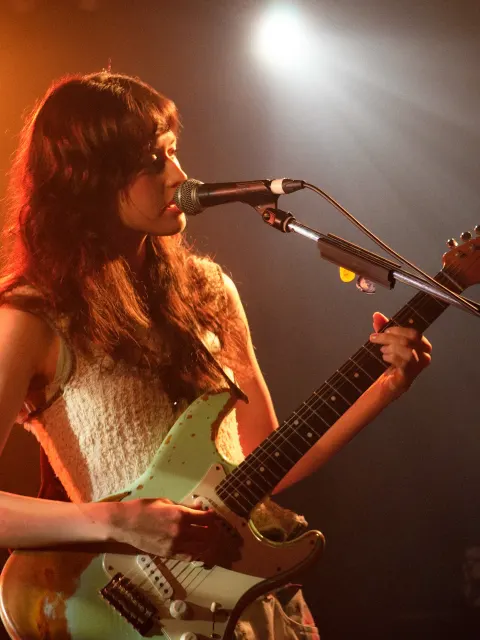
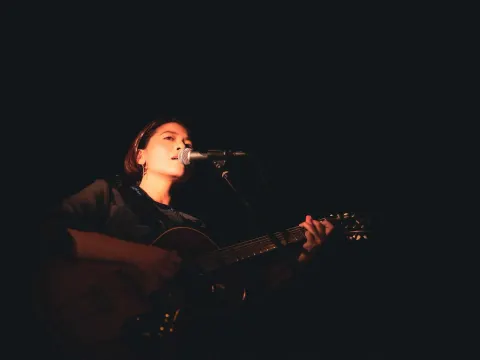
When the show began, the evening's guest REJAY appeared alone onstage. Holding a Stratocaster, she began singing ‘Remedy’ without a backing track. Perhaps a touch of chorus effect was in use: the guitar's subtly wavering sound felt pleasant. The performance consisted only of that guitar and a voice gently expressing her inner world, but it quickly drew the listeners into deep concentration.
After a brief greeting, she began ‘Shaky,’ playing a bossa nova rhythm on guitar and singing over synchronized drums and bass, completely transforming the scene. Reverb on her voice opened up a deep sense of space, and the sounds she produced enveloped the venue. The fragile, delicate nuances of her falsetto held her individuality as a singer. Next came ‘HAZY(Prod. A.G.O),’ its contemporary bedroom-style drum-and-bass beat light and cool. That range suggested her background: growing up listening to diverse genres under the influence of her Australian father. The appeal of her bilingual pronunciation and vocal delivery, and lyrics mixing Japanese and English, was also unmistakably REJAY's.
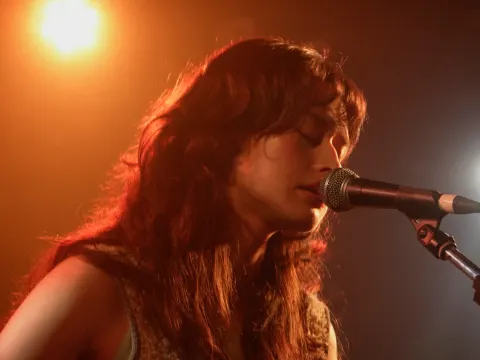
‘ラナメリサ and I are close in age; she's perhaps a little older than me? I was so happy to be invited to her own event, and I feel so much energy from her that it makes me think I need to work harder, too,’ REJAY said between songs. Her slightly husky voice had something in common with ラナメリサ's. After announcing her first solo show in Japan, scheduled for October, she introduced the next song in English: ‘The next song is “Too Late”.’ An introspective world akin to ‘Remedy’ filled the stage and floor. Fitting for an artist discovered by JQ of Nulbarich, her singing, with the intimacy of Frank Ocean-like R&B, touched the heart. ‘Let’s Just to Be’ followed, once again performed with voice and guitar alone. Relaxed yet deeply earnest, her voice sustained each note, including the high ones, clearly conveying her strength at the core as a singer.
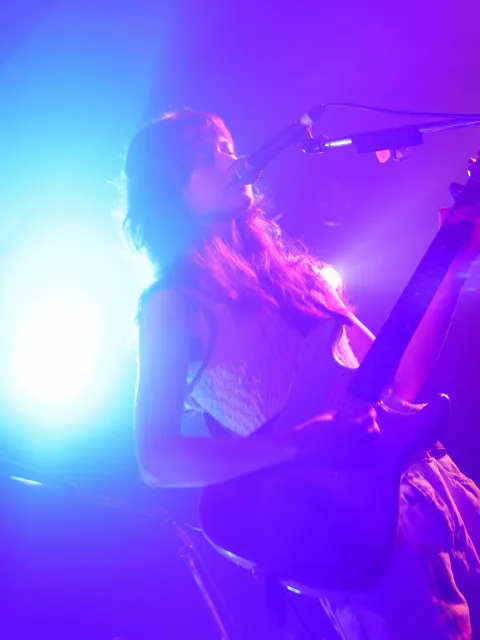
‘Thank you so much for today. That was REJAY,’ she said in farewell before performing ‘Middle of the Night’ and ‘Meant to Be’ in succession. In the former, a key change in the second half vividly expanded the musical landscape. In the latter, she sang over a track with an indie-rock feel, the interplay between its light beat and her emotionally saturated voice forming a wistful marriage. ‘Thank you!’ With that, REJAY left the stage. Her individuality and musical direction as a singer-songwriter differ from ラナメリサ's, but the expressive power to hold a performance together with just voice and guitar was certainly something they shared.
REJAY's performance inhabited an inward-looking world in which her singing gradually seeped into the listeners' hearts. The event's host ラナメリサ, however, delivered the exact opposite: a live set that forcefully blasted away every melancholy and pent-up feeling at tremendous volume. That contrast embodied another pleasure of a joint-bill show. Here was the beauty of a two-act concert: an event where both the contrast and the connections between the two could be savored.
Above all, ラナメリサ's performance this time was astonishing. The previous set, centered on an acoustic trio of her own guitar and vocals, 石井ゆかこ on bass and MITSU on drums, had been fresh in its own way. This time, in a complete change, they were a quartet with 近藤寿 on electric guitar. Beyond the difference in lineup, the arrangements had become aggressively different. In a word: rock. The band's bold, unmistakably rock performance brilliantly expanded and amplified ラナメリサ's bluesy, sensual singing world.
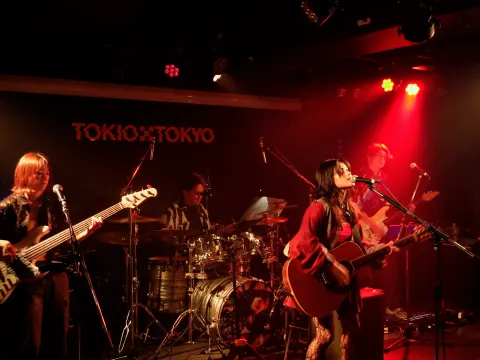
The first song was 奪い愛. Right at the outset, after a bluesy fingerplayed acoustic-guitar phrase, the drums and instruments struck a tight unison, and the sheer volume was enough to make me flinch. ラナメリサ strummed her acoustic guitar and sang high notes with an urgent edge. As the chorus arrived, cheers and handclaps were already breaking out. Could adding an electric guitar to lead the performance change it this much? My eyes and ears were riveted.
She murmured ‘Thank you’ in a raspy voice, then continued with ‘DUMMY,’ another performance in which a singer-songwriter's intense personal emotion coexisted with rock dynamism. The ska-like offbeat rhythm was buoyant, but the heat in the voice carried weight. In the latter half, the audience on the floor again lifted the energy with handclaps.
Then, after announcing ‘I'm ラナメリサ!’ in a slightly rough-edged voice, she asked, ‘Having fun? Summer is coming to an end, so I'll sing my summer song,’ and began 夏一辺倒. Its grunge-like structure had become even more intense and dynamic. The contrast between the hushed first verse and the emotionally explosive chorus, and the breadth of that range, were greatly enlarged by the four-piece band's performance. ラナメリサ's desperate plea, 「来て 来て 来て」, was overwhelming. This was unquestionably the day's first highlight.
The highlights did not stop at one song. In 街灯に恋したい, where wah guitar created a soulful groove, her voice climbing into the high register and the vividly descriptive lyrics scattered a coiling intensity of emotion. Her guitar harmonics, placed with exquisite timing, also landed perfectly. 焼ける肌 likewise radiated searing emotion in her singing against fiercely distorted electric guitar.
She performed the next song, エロス, entirely as a solo vocal-and-guitar piece. As ever, the singing in エロス was intense. The force of her snarling delivery, reminiscent of 椎名林檎, was tremendous. My eyes also kept going to her guitar-playing hands. Even a simple chord strum conveyed ラナメリサ's familiarity with acoustic guitar. The way she distinguished the low notes on the fifth and sixth strings and flexibly switched between fingerplaying and a pick according to the song was deeply convincing.
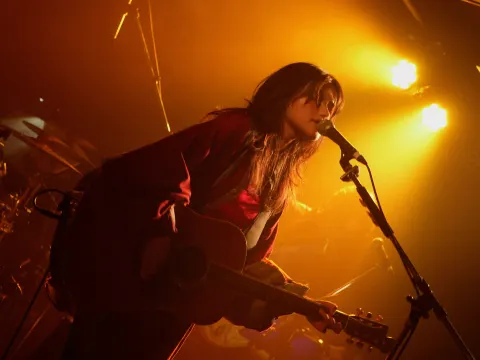
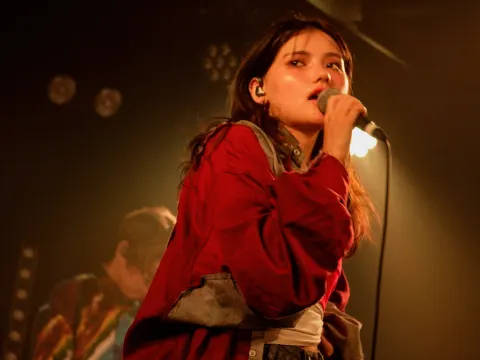
‘Once again, thank you for coming to 太陽に妬かれて Vol.3! We're already halfway through before we know it. I'm glad it's sunny today. Well, maybe it's not,’ ラナメリサ said in her husky voice, with the previous day's heavy rain in Tokyo in mind. When the lighting illuminated the stage and floor, her red-centered outfit—a vintage-looking oversized jacket, fitted top, denim shorts, tights and large earrings—caught the eye. Her presence was striking, too.
She also reflected on appearing at RISING SUN ROCK FESTIVAL 2026 in EZO, saying she had ‘been given the chance to experience so much this summer.’ It made sense that this newly enlarged performance came from the growth of playing a major stage. Introducing the band, she paid homage to 忌野清志郎 with ‘Let me introduce these cool members!’ before drawing laughter with ‘Guitar—I forgot to mention him earlier! It's 寿!’ The power of the drums was a major difference between this electric set and an acoustic one, though she described it loosely as ‘those drums that go BANG!!,’ making the audience laugh again.
After urging the floor on with ‘You can still keep going from here, right!?’ she performed ドライブコールガール, a song she said she had kept under wraps. Wah guitar laid down a sixteenth-note groove, while ラナメリサ raced through a vocal packed with words, almost like rap. The way the performance tumbled into a 6/8 rhythm near the end was also excellent. It is far too good a song to keep hidden.
Next came 海月, which also used a synchronized electronic beat, and MITSU asked the audience for handclaps. Her expansive voice soared through the chorus. The phrases 「溢れてしまう」 and 「流れてしまう」 seemed to express the emotions that ラナメリサ cannot help communicating through music.
‘The last two songs—let's get excited!’ she called, and then that familiar plucked acoustic-guitar figure reached our ears. It was 愛でてよベイベー. Metallically distorted guitar ran wild, and with the band playing fiercely behind her, the longing and mixture of love and hate in her singing became frighteningly harder and heavier. Here again, ラナメリサ nailed her harmonics at just the right, satisfying moments. The extraordinary performance of 愛でてよベイベー was naturally the day's second highlight.
‘I'd be happy if you raised your hands,’ she said as she began the main set's final song, BAD愛. Facing the audience's handclaps head-on, ラナメリサ sent her clear, soaring voice straight forward. ‘Everyone, sing at the end!’ she asked, and the crowd answered. After the intensely emotional songs, it was a pleasingly refreshing close. Leaving just a single ‘Thank you!’ behind, she departed the stage.
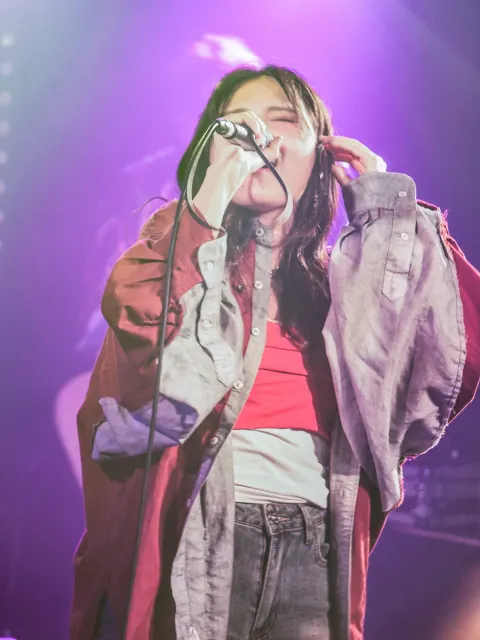
Naturally, the audience wanted an encore, and the applause would not stop. The band and ラナメリサ quickly returned to the stage. After thanking REJAY, she asked, ‘We performed with this new band lineup—what did you think?’ The audience answered with another great round of applause.
After sharing the care she had put into merchandise she had designed herself, she said, ‘Thank you for making one final summer memory with me! I'd like to bring you a new song,’ and surprised the audience with ‘VENUS.’ This revealed another new side of ラナメリサ. The performance leaned toward hard rock reminiscent of Arctic Monkeys or Måneskin, with a memorable guitar riff. Her superb vocalization, traveling between seductive, alluring low notes and high ones, and the expression of her characteristically sensual lyrics shone. She pushed the microphone stand aside and sang into a handheld mic, moving from side to side across the stage. Watching her sing, I honestly felt her star quality.
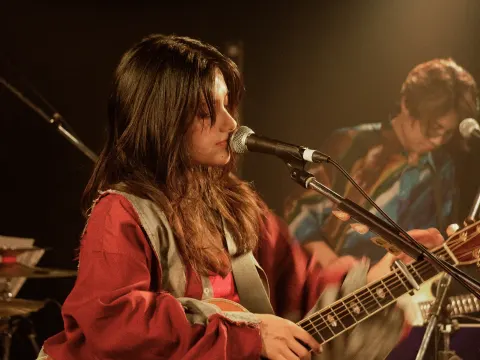
ラナメリサ again sang a generous eleven songs. I felt that both the scale and the setlist could support a solo show in a large venue. Because she has always loved rock bands, this set let her expression soar freely, lively and at ease, like a fish in water. Onstage was a new, rock-oriented ラナメリサ, visibly enjoying herself from the heart.
‘A woman who had no choice but to become a singer-songwriter’ is the phrase in her Instagram profile and elsewhere. I think ‘had no choice’ is the crucial part. Every time I hear ラナメリサ sing, I feel acutely that she must be filled inside with impulses and desires that make singing and expression unavoidable. This concert was the release of those swirling inner feelings as song and music, launched by the catapult of a rock band.
Text: 天野 龍太郎
LIVE
SOUND OF 3 COLORS
Date: September 17, 2026 (Thu.) OPEN 18:30 / START 19:00
Venue: Shibuya CLUB CRAWL
With kolks and 叶芽フウカ
Tickets go on sale August 30 (Sun.) at 10:00
Ticket URL:https://eplus.jp/sf/detail/4594240001-P0030001
SNS
ラナメリサ Official YouTube Channel:https://youtube.com/@lana_melyssa
Instagram:https://www.instagram.com/lana_melysss
TikTok:https://www.tiktok.com/@lana_melysss
ラナメリサ Staff X:https://x.com/LanaMelyssa_mgr
ラナメリサ at For Life Music:http://www.forlife.co.jp/artist/fl01570/